research · 2024
CollageVis: Rapid Previsualization Tool for Indie Filmmaking using Video Collages
ACM CHI · Acceptance 26.4%
@inproceedings{10.1145/3613904.3642575,
author = {Jo, Hye-Young and Suzuki, Ryo and Kim, Yoonji},
title = {CollageVis: Rapid Previsualization Tool for Indie Filmmaking using Video Collages},
year = {2024},
isbn = {9798400703300},
publisher = {Association for Computing Machinery},
address = {New York, NY, USA},
url = {https://doi.org/10.1145/3613904.3642575},
doi = {10.1145/3613904.3642575},
booktitle = {Proceedings of the 2024 CHI Conference on Human Factors in Computing Systems},
articleno = {164},
numpages = {16},
location = {Honolulu, HI, USA},
series = {CHI '24}
}
%0 Conference Paper %T CollageVis: Rapid Previsualization Tool for Indie Filmmaking using Video Collages %@ 9798400703300 %U https://doi.org/10.1145/3613904.3642575 %R 10.1145/3613904.3642575 %B Proceedings of the 2024 CHI Conference on Human Factors in Computing Systems %I Association for Computing Machinery %A Hye-Young Jo %A Ryo Suzuki %A Yoonji Kim %D 2024 %P Article 164 %K indie filmmaking, previsualization, storyboard %C Honolulu, HI, USA
Hye-Young Jo, Ryo Suzuki, and Yoonji Kim. 2024. CollageVis: Rapid Previsualization Tool for Indie Filmmaking using Video Collages. In Proceedings of the 2024 CHI Conference on Human Factors in Computing Systems (CHI '24). Association for Computing Machinery, New York, NY, USA, Article 164, 1–16. https://doi.org/10.1145/3613904.3642575
CollageVis is a rapid previsualization tool that lets indie filmmakers compose scenes from video collages, with automatic actor segmentation, name tags and face swaps, role assignment, layer positioning, and mobile-based virtual camera recording. A study with six indie filmmakers showed it enables flexible and expressive previsualization.
Problem: previs is out of reach for indie filmmakers
Before shooting, directors work with storyboard artists or animators to visualize their ideas, a step called previsualization (previs) that is crucial for creative decisions and collaboration. But traditional previs (2D storyboards, 3D animation) takes substantial time, money, and technical skill. Big-budget teams can absorb that; indie filmmakers usually can’t.
Solution: previs from video collages
CollageVis lets filmmakers build previs by collecting short video clips and compositing them into a video collage. Video recording is already a familiar tool for filmmakers, and the resulting collage is easy for technical and non-technical collaborators alike to read. The image below is a previs we made replicating a scene from Squid Game.
Two interfaces
The system runs mainly on a laptop, with a phone as a supplementary camera tool.
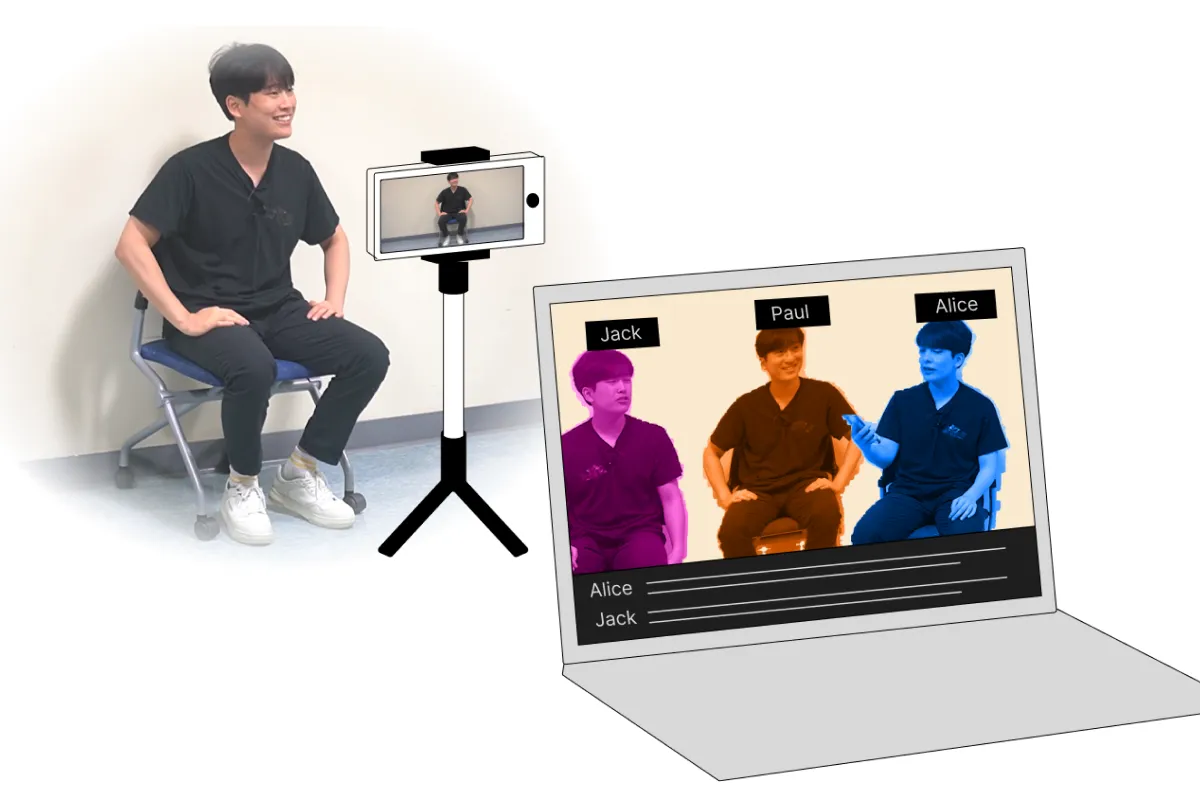
① Collage Board: source collection & modification. It takes videos (a test shot of a real actor, or a crew member standing in) and composites them on a board in real time, with an image as the backdrop. Name tags, color filters, and face-swap filters distinguish each character.
② Virtual Stage: layout & camera exploration. For more complex shots, it simulates a detailed 3D shooting environment (weather, location) where the user lays out actors, crew, lighting, and multiple cameras. The companion mobile app drives a virtual camera, so camerawork can be explored without 3D-software expertise. The system then outputs a previs video plus a floor-plan video tracing each element’s movement.
We grounded these features in formative interviews with indie filmmakers, replicated seven film scenes to demonstrate the system, and evaluated it with six indie filmmakers, who found it a more flexible yet expressive way to develop and communicate ideas.